
- 12 - - 13 -
Changing the power cord (HL 2020 E only)
I
f the power cord is damaged, it can easily be changed
without opening the casing.
1. Important! Disconnect tool from power supply.
2. Undo screw and remove cover cap .
3. Release cable grip .
4. Undo mains terminals .
5. Pull out cord .
6. Insert new cord and secure in reverse order
(1. Firmly screw down mains terminals etc.).
e
a
d
b
c
14
Residual heat indicator
(HL 2020 E only)
The residual heat indicator serves as
a visual warning to prevent injury
from direct contact with the hot
nozzle outlet. The residual heat indi-
cator also works when the tool is
unplugged.
The indicator starts working after the
tool has been in use for 90 seconds
and keeps flashing until the temper-
ature at the nozzle outlet has fallen
below 60 °C at room temperature.
The residual heat indicator does not
show if the tool has been in opera-
tion for less than 90 seconds. Re-
sponsibility always rests with the
user and care must be taken at all
times when handling hot air tools.
Keep these safety precautions
with the tool.
Safety warnings
These hot air tools are doubly protected from overheating:
1. A thermostat switches the heater off if too much of the
air outlet nozzle is obstructed (heat build-up). However,
the blower continues to run. A warning triangle on the
display tells you that the heater is switched off.
Once the air delivery nozzle is clear again, the heater au-
tomatically switches back on again after a few moments.
The warning triangle then goes out. The thermostat may
also respond after switching the hot air tool off, taking it
longer than usual to reach temperature at the air delivery
nozzle when it is switched on again. *
2. The thermal cut-out completely shuts down the tool if it is
overloaded.
* for HL 2020 E only
For your safety
Tool description - Operation
P
lease note: The distance from the object you are working
on depends on material and intended method of working.
A
lways try out the airflow and temperature on a test piece
first. Using the attachable accessory nozzles (see acces-
sories page on the cover) the flow of hot air can be con-
trolled with maximum precision. Take care when changing
hot nozzles! When using the hot air tool in the self-resting
p
osition, make sure it is standing on a stable, non-slip and
clean surface.
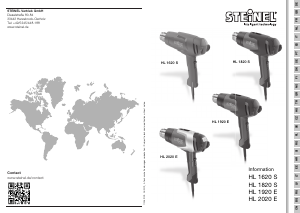
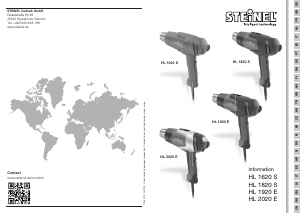
HL 1620 S
T
he tool is switched on and off at the two-stage switch
on the back of the grip handle. Airflow and temperature can
be adjusted to 2 settings. Stage 1 reaches 300 °C at an
airflow of 240 l/min, stage 2 reaches 500 °C at 450 l/min.
This tool is intended for home use only.
HL 1820 S
The tool is switched on and off via the three-stage switch
on the back of the grip handle. Airflow and temperature
can be adjusted to 3 settings. Stage 1 (cool air stage)
reaches 50°C at an airflow rate of 100 l/min, stage 2 reach-
es 400°C at 300 l/min and stage 3 reaches 600°C at
500 l/min. The guard sleeve detaches by means of a
bayonet catch.
HL 1920 E
The tool is switched on and off at the two-stage switch
on the back of the grip handle. In addition to three-stage
speed/airflow control (stage 1 is a cold-air stage at 80 °C),
temperature can be continuously adjusted over a range of
80 °C – 600 °C in settings 2 and 3 at the thumbwheel .
The numbers 1 - 9 on the thumbwheel serve as a guide
only. Whereas "1" means 80 °C, the maximum temperature
of 600 °C is attained at "9". Airflow can be adjusted to the
three stages of 150 / 150-300 / 300-500 l/min. The guard
sleeve detaches at a bayonet catch.
HL 2020 E
The tool is switched on and off at the two-stage switch
on the back of the grip handle. In addition to three-stage
speed/airflow control at the switch , temperature can be
continuously adjusted over a range of 80 °C to 630 °C in
settings 2 and 3 at the rocker switch . The target temper-
ature can be increased in 10 °C increments by pressing the
right-hand "+" side of the rocker switch or reduced by
pressing the left-hand "–" side of the rocker switch .
Keeping the button pressed will continue to increase or re-
duce the temperature in steps of 10 °C until the rocker but-
ton is released or the minimum or maximum temperature is
set. The temperature setting is shown on the display for
3 seconds. On lowering or increasing the temperature, the
actual temperature is then displayed at the delivery nozzle.
The °C/°F symbol flashes during this period. As soon as the
selected temperature is reached, this symbol stops flashing
and is displayed all the time. Blower stage 1 delivers a tem-
perature of 80 °C. When the tool has been operating at high
temperatures on blower stage 2 or 3 it will take a short while
to cool to 80 °C after switching down to blower stage 1.
While the tool is cooling down, the LCD display shows
the actual temperature at the nozzle outlet. After switching
off, the tool stays in the last setting that was selected. The
guard sleeve detaches at a bayonet catch.
7
3
GB
7
8
3
7
7
9
9
10
3
7
9
13
Uses
H
ere are some of the applications you can use STEINEL hot
air tools for. This selection is by no means exhaustive – no
d
oubt you can immediately think of other examples.
P
aint stripping:
Paint is softened and can be removed with a stripping knife
a
nd paint scraper to leave a clean surface.
Shrinking tubing on cables:
The shrink tubing is slipped over the section you want to in-
s
ulate and heated with hot air. The tubing shrinks by approx.
50% in diameter to give a sealed union. Shrinking is particu-
l
arly fast and even using reflector nozzles. Sealing and sta-
bilising cable breaks, insulating soldered joints, gathering ca-
ble runs, sheathing terminal blocks.
Forming PVC:
Sheeting, piping or ski boots can be softened and formed
with hot air.
Lighting barbecues:
Gets charcoal glowing in next to no time; no more waiting.
Thawing:
Water pipes, frozen door locks, steps. Gently thaws and
dries all in one go.
Soft soldering:
First, clean metal parts you want to join. Then, using hot air,
heat the point you want to solder and offer up the soldering
wire. Use flux or a soldering wire with a flux core to prevent
oxide forming.
Welding and joining plastic:
All parts being welded must be of the same plastic material.
Use an appropriate welding rod.
Joining sheeting:
The sheets are overlapped and welded together. A slit
nozzle is used to direct hot air under the overlap, then the
two sheets are firmly pressed together with a feed roller.
Also possible: Repairing PVC tarpaulins by overlap weld-
ing with a slit nozzle.
Tool features
Stainless steel outlet nozzle
Air inlet with lattice guard keeps out foreign matter
Removable guard sleeve
(for places that are hard to reach)
Soft stand and soft end cap for firm standing and
non-slip stationary use
Heavy-duty rubber-insulated power cord
Multiple-stage switch for adjusting airflow
(2-stage/3-stage)
Thumbwheel for setting temperature
Button for setting temperature
LED indicator for monitoring temperature
Soft grip handle for comfortable operation
Hanging capability
Residual heat indicator (HL 2020 E only)
Replaceable mains power cord (HL 2020 E only)
1
11
12
13
14
2
3
4
6
7
8
9
10
5


Alăturați-vă conversației despre acest produs
Aici puteți împărtăși ce părere aveți despre Steinel HL 1820 S Suflanta cu aer cald. Dacă aveți o întrebare, citiți mai întâi cu atenție manualul. Solicitarea unui manual se poate face folosind formularul nostru de contact.